1. See how customers find and verify your business
Start by putting yourself in the position of someone who has heard your business name but does not already know where to go. Search for the business and look at what appears before assuming that a website is either necessary or unnecessary.
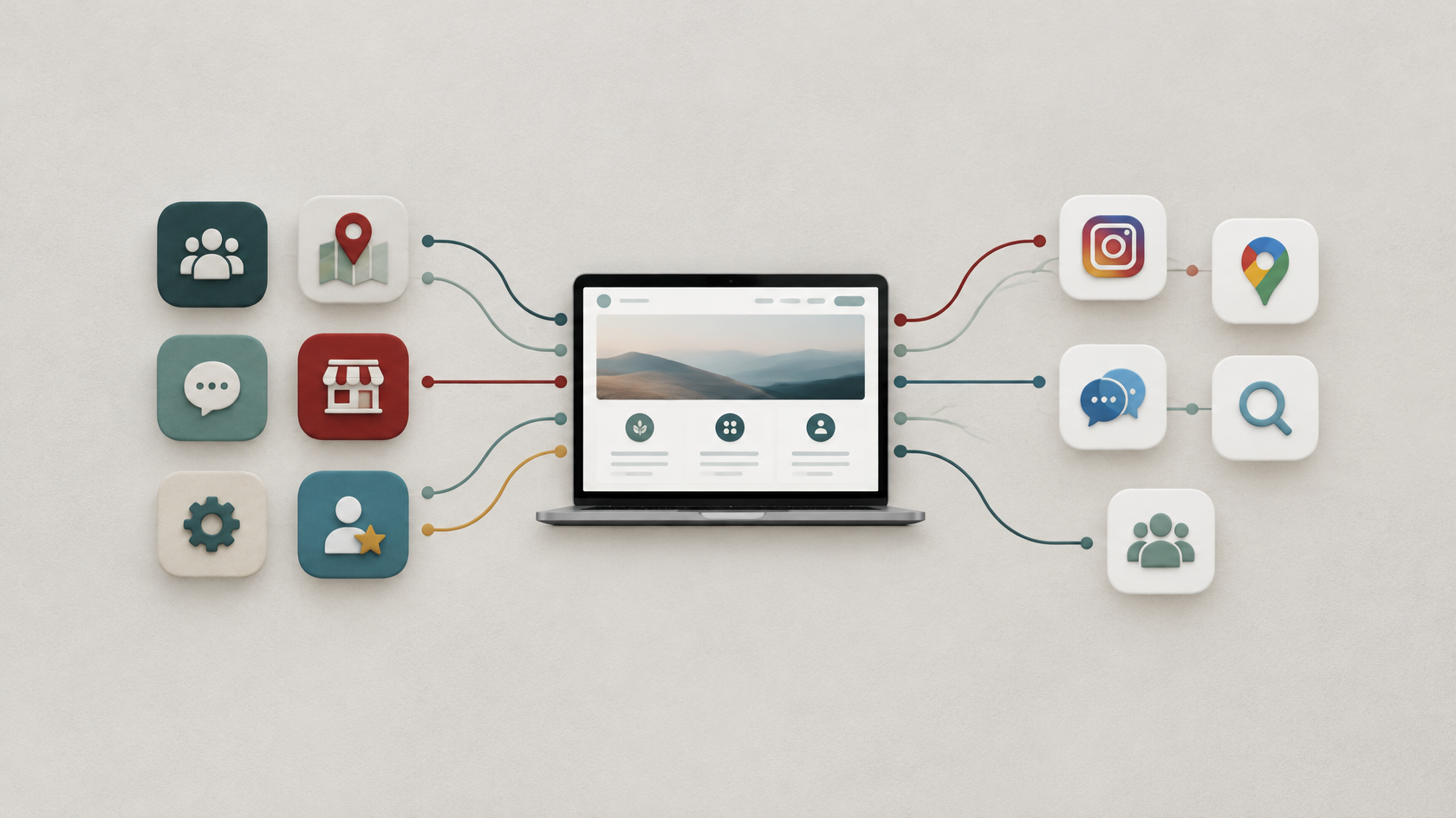
Social profiles and business listings can already do useful work. For example, Google says a Business Profile can appear on Search and Maps and can show information such as hours, contact details, photos, reviews, products or services, and updates. Some businesses are able to also give customers ways to order, reserve, book, or request quotes from the profile.
How to check
- Search for your exact business name on a phone and a computer.
- Look at what a first-time customer can see without logging into one of your social accounts.
- Open your main social profiles and applicable business listings.
- Check whether the business name, contact information, hours, location or service area, services, and other important details agree across them.
- Ask whether someone unfamiliar with the business could understand what you offer and where to go next.
What you're looking for
You are looking for gaps rather than trying to prove that one platform is better than another. If search results, business listings, and social profiles already help the right customers understand the business and take the appropriate next step, that is useful infrastructure. If information is scattered, inconsistent, difficult to verify, or dependent on someone finding the right post, a website may have a clearer role.
Don't panic if
Your website is not the first thing that appears every time someone searches. Customers may encounter a business through search results, maps, social platforms, directories, advertisements, and referrals. The goal is to understand that experience and keep important information consistent and useful.
AP Web Tech's Tip
Do this review logged out of your own accounts when practical. Business owners often see administrative tools, familiar navigation, and personalized results that a prospective customer may not see.
2. Check whether customers can get the information they need
Next, look beyond whether your business can be found. Ask whether someone can understand enough about the business to decide what to do next without putting together information from old posts, profile descriptions, comments, and multiple platforms.
How to check
- Write down the five or six questions a prospective customer is most likely to need answered before contacting or buying from you.
- Depending on the business, that might include what you offer, who you serve, where you operate, hours, pricing or starting-price information, how the process works, policies, examples of work, frequently asked questions, or how to contact you.
- Try to answer those questions using only the online presence currently available to a customer.
- Notice when important information is buried in an old social post, spread among several profiles, missing, or inconsistent.
- If you already have a website, perform the same test there rather than assuming that having a site automatically solves the problem.
What you're looking for
A website becomes especially useful when your business needs a more organized destination for information that doesn't fit comfortably in a profile or stream of posts. Service pages, product details, FAQs, policies, project information, contact options, and other durable content can each have a clear place instead of relying on customers to find the right update.
Don't panic if
Your business does not need dozens of pages. If customers only need a small amount of information before taking action, a focused website may be more appropriate than a large one. The website should be as large as the job requires.
3. Test whether customers have a clear next step
The strongest reason to reconsider your present setup may not be where the business appears online. It may be what happens when someone is ready to act.
How to check
- Identify the most important action you want a prospective customer to take.
- That could be calling, sending an inquiry, requesting a quote, scheduling an appointment, buying a product, visiting a location, subscribing, or another action appropriate to the business.
- Start from search, a social profile, or an existing website, then try to complete that action yourself.
- Count how many different profiles, links, messages, or pages you have to navigate before reaching the actual next step.
- Check the process on a phone as well as a desktop computer.
What you're looking for
Look for unnecessary friction. Social media may already provide a reasonable action for your business. In other situations, a website can provide a more direct destination for forms, booking, e-commerce, detailed service information, lead capture, or other functionality. Social platforms can still support discovery and community.
Don't panic if
The answer is not simply “website” or “social media.” Many firms can use both for different jobs. Social platforms may be valuable for updates, interaction, and discovery, while a website can serve as a more structured destination for detailed information or a specific action.
AP Web Tech's Tip
Decide what the website needs to accomplish before deciding how large or technically complicated it should be. A focused site that solves a clear customer problem can be more useful than a larger site created simply because a business thinks it should have one.
Frequently asked questions
Can my business appear on Google without a website?
Yes, a website is not the only way a business can appear on Google. Google says eligible businesses are able to use a Business Profile to appear on Search and Maps, provide business information, post updates, display products or services, manage reviews, and support certain customer actions. A website can complement those tools.
Should I replace social media with a website?
Usually that is the wrong question. If social media is helping customers discover the business, follow updates, ask questions, or participate in a community, there may be no reason to abandon it. The better question is whether customers also need a clearer destination for information or actions that social profiles do not organize well for your situation.
Does every small business need a large website?
No. The appropriate scope depends on what customers need and what the business needs the website to accomplish. A focused site with a few useful pages may be enough for one business, while another may genuinely need ecommerce, booking, integrations, detailed service content, or other functionality.
What should a simple small-business website include?
Start with the customer rather than a page-count target. Clearly explain what the business offers, who or the areas it serves when relevant, how to contact or take the next step, and the information a customer reasonably needs before doing so. Add pages or functionality when they have a specific purpose.
What if I already have a website but most customers find me on social media?
That does not automatically mean the website is unnecessary. Review what happens after discovery. The website may still provide detailed information, forms, booking, purchasing, search-focused content, or a dependable destination referenced from multiple channels. If it serves no clear purpose, that is useful information too and a reason to reconsider what the site should do.